

Refurbished Medical Equipment Market to Reach US$ 30.9 Billion by 2033 at 5.6% CAGR | Persistence Market Research
Refurbished Medical Equipment Market
BRENFORD, LONDON, UNITED KINGDOM, August 10, 2026 /EINPresswire.com/ -- The global Refurbished Medical Equipment Market is gaining momentum as healthcare organizations seek cost-efficient ways to expand diagnostic and treatment capabilities. Refurbished equipment provides hospitals, diagnostic centers, specialty clinics, and other healthcare facilities with access to advanced technologies while reducing capital expenditure. Growing healthcare infrastructure, rising diagnostic workloads, increasing emphasis on equipment lifecycle management, and stronger acceptance of professionally restored devices are supporting demand. Diagnostic imaging equipment remains a leading product category because high acquisition costs encourage healthcare providers to consider certified refurbished alternatives.
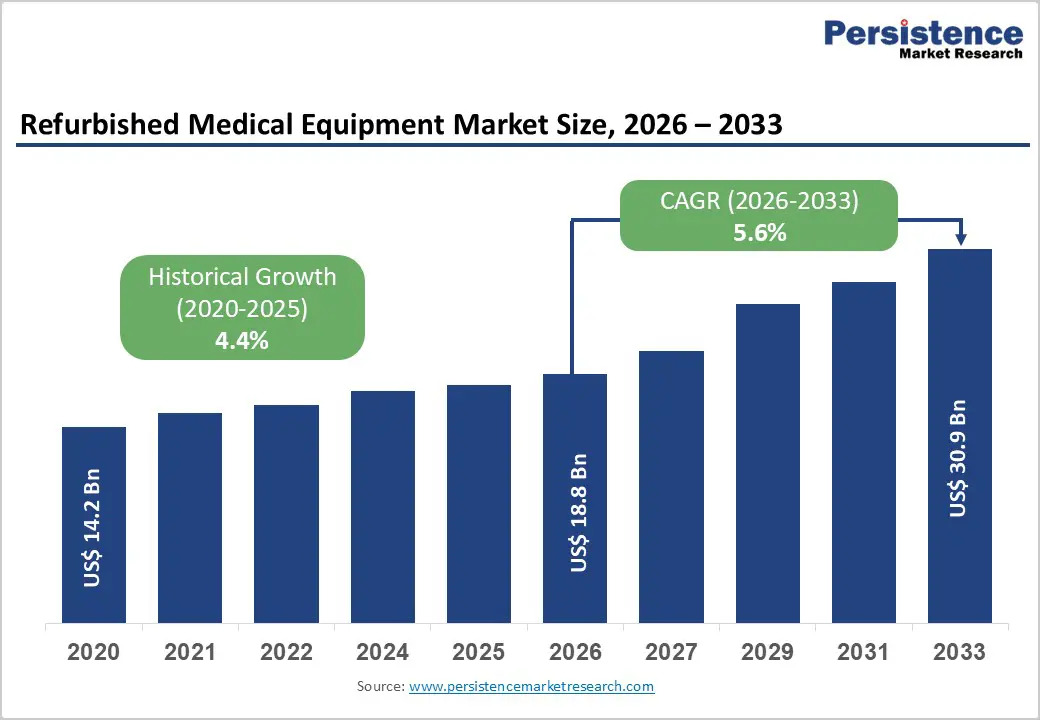
According to Persistence Market Research, the global refurbished medical equipment market is estimated to grow from US$ 18.8 billion in 2026 to US$ 30.9 billion by 2033, recording a CAGR of 5.6% from 2026 to 2033. North America is expected to remain a prominent regional market, supported by established refurbishment networks, significant installed medical equipment bases, and widespread acceptance of certified pre-owned systems. Growing demand from emerging healthcare markets is also creating opportunities for suppliers offering reliable equipment, warranties, maintenance, and technical support.
Want Market Insights? Get Your Free Report Sample : https://www.persistencemarketresearch.com/samples/35242
Key Highlights from the Report
➤ Growing pressure on healthcare providers to optimize capital expenditure is encouraging adoption of professionally refurbished medical devices.
➤ Diagnostic imaging systems remain important due to their high replacement costs and substantial demand across hospitals and diagnostic facilities.
➤ OEM-certified refurbishment programs are strengthening buyer confidence through standardized inspection, testing, servicing, and quality-control procedures.
➤ Emerging healthcare economies represent attractive opportunities as providers seek affordable access to advanced diagnostic technologies.
➤ Sustainability initiatives and circular healthcare models are encouraging reuse, refurbishment, equipment recovery, and longer technology lifecycles.
Market Segmentation
The market can be segmented by equipment type into diagnostic imaging equipment, patient monitoring devices, operating room and surgical equipment, cardiology equipment, laboratory equipment, and other medical systems. Diagnostic imaging equipment, including MRI, CT, ultrasound, mammography, X-ray, and nuclear imaging systems, represents a significant area for refurbishment because these systems involve substantial capital investment.
By end user, demand comes primarily from hospitals, diagnostic imaging centers, specialty clinics, ambulatory facilities, and other healthcare organizations. Hospitals represent a leading customer group because they operate diverse equipment portfolios and frequently balance technology modernization with budget limitations. Smaller healthcare facilities increasingly consider refurbished systems to improve clinical capabilities without purchasing entirely new equipment.
Regional Insights
North America remains an important market owing to established secondary equipment channels, OEM refurbishment programs, developed hospital infrastructure, and demand for cost-efficient technology replacement. Healthcare providers increasingly evaluate equipment based on lifecycle economics, warranty coverage, service availability, software compatibility, and expected operating performance.
Asia Pacific offers considerable long-term opportunities as healthcare infrastructure expands and diagnostic capacity increases. Refurbished medical equipment can help hospitals and diagnostic facilities acquire sophisticated technologies within constrained budgets. Europe also demonstrates demand supported by circular-economy principles, equipment reuse strategies, sustainability objectives, and structured refurbishment practices.
Customize This Report for Your Exact Requirements : https://www.persistencemarketresearch.com/request-customization/35242
Market Drivers
Cost optimization remains a major market driver. Hospitals face continuous pressure to modernize clinical infrastructure while controlling capital expenditure. Refurbished equipment provides an alternative for organizations requiring advanced technology without purchasing new systems. Increasing diagnostic volumes, hospital expansion, and growing demand for specialized medical services further support adoption.
Another driver is improving confidence in OEM-certified refurbishment. Professional programs can include inspection, component replacement, cleaning, software updates, performance testing, installation, warranties, and after-sales support. These processes help differentiate professionally refurbished equipment from conventional used equipment and strengthen purchasing confidence.
Unlock Complete Insights – Buy the Full Report : https://www.persistencemarketresearch.com/checkout/35242
Market Restraints
Concerns surrounding equipment quality, remaining operational life, maintenance history, software compatibility, and availability of replacement parts can limit adoption. Healthcare organizations require assurance that refurbished systems comply with relevant safety and performance requirements.
Regulatory differences across countries can also complicate international distribution. Transportation, installation, calibration, maintenance, technical training, and service availability can influence total ownership costs, particularly for sophisticated imaging systems.
Market Opportunities
Emerging economies provide substantial opportunities as hospitals expand diagnostic capabilities while operating under capital constraints. Refurbished imaging and clinical equipment can improve access to technology across smaller hospitals, independent diagnostic centers, and specialty facilities.
Circular healthcare strategies provide another opportunity. Manufacturers and refurbishment specialists can develop equipment take-back, trade-in, remanufacturing, parts recovery, lifecycle management, and maintenance programs that extend equipment usability while supporting sustainability objectives.
Company Insights
Prominent participants include GE HealthCare, Siemens Healthineers, Philips, Canon Medical Systems, Block Imaging, Soma Technology, Avante Health Solutions, Integrity Medical Systems, EverX, and Atlantis Worldwide. Competition increasingly centers on equipment quality, certification, warranties, technical expertise, inventory availability, installation capabilities, and after-sales service.
Explore the Latest Trending Research Reports:
Europe Telepharmacy Market
Brain Health Supplements Market
Persistence Market Research
Persistence Market Research Pvt Ltd
+1 646-878-6329
email us here
Visit us on social media:
LinkedIn
Instagram
Facebook
YouTube
X
Legal Disclaimer:
EIN Presswire provides this news content "as is" without warranty of any kind. We do not accept any responsibility or liability for the accuracy, content, images, videos, licenses, completeness, legality, or reliability of the information contained in this article. If you have any complaints or copyright issues related to this article, kindly contact the author above.
