

Medical Solenoid Valve Guide: How to Compare and Choose the Right Valve
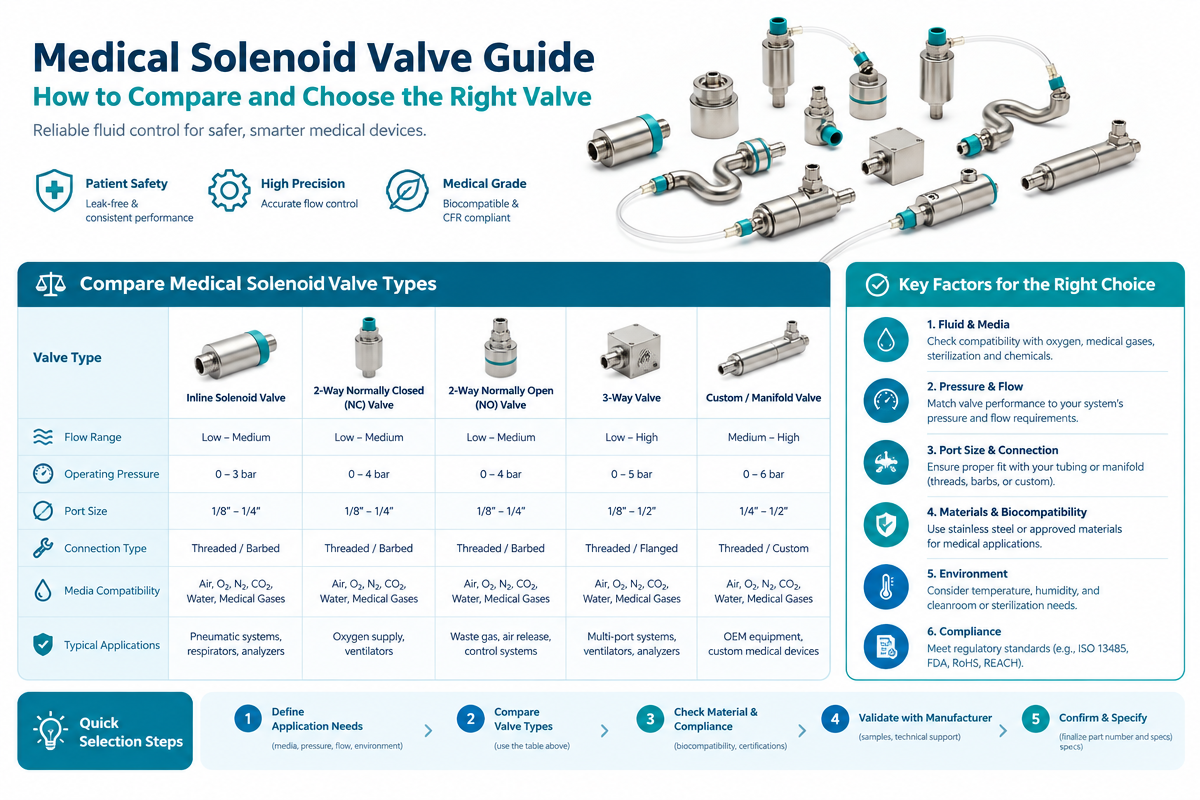
Control of fluids and gases is a crucial function of many medical devices. Valves can be vital components of ventilators, oxygen delivery systems, diagnostic analyzers, laboratory equipment, dialysis systems, anesthesia delivery systems, suction devices and other medical devices, where controlling the flow, isolating the flow, measuring the flow or stopping the flow.
Selecting the proper medical solenoid valve goes far beyond the voltage and connection size.
Requirements for the leakage, reaction time, power consumption, heating, material compatibility, cleanliness, noise, life span and dimensional stability for the medical devices can be very demanding. For compact portable medical devices one of the key selection criteria may even be valve size and weight.
2. What Is Medical Solenoid Valve?
Medical solenoid valve is an electric valve that is used to control the flow of gases or liquids in medical devices, diagnostic equipment, laboratory equipment and healthcare related devices.
The principle of work is fundamentally electromagnetic.
A typical solenoid valve includes:
Electromagnetic coil
movable armature or plunger.
Valve seat or orifice.
Sealing components
spring
Valve body
Inlets, outlets, exhausts.
The coil, when current passes through it, produces a magnetic field. This field moves the armature to open, close or change the flow direction.
Valve may be either simple on/off valve or more sophisticated flow-control system.
For medical devices small size, high accuracy and repeatability, low leakage, quick response, low power and compatibility with carefully controlled media become critical parameters.
Therefore, the choice of the medical solenoid valve should be made according to the application specification, and not catalog numbers.
3. Define the Medium First
The first step in specifying valve is quite obvious:
What gas or liquid will be used in the valve?
Media can be:
Air Oxygen,
Nitrogen (N),
Water
Saline or any other appropriate aqueous solution
Reagent
Cleaning fluids
Vacuum
Other process gases or fluids
3.1 Medium confirmation
Medium compatibility affects almost every aspect of valve selection.
The medium should be considered for body, plunger, spring, diaphragm, seals, lubricants, adhesives and other wetted parts.
A valve suitable for clean air should not be considered as suitable for oxygen, aggressive reagents or biofluid related applications.
In case of equipment that processes sensitive media the detailed information on the composition of the fluid, its concentration, temperature, pressure and duration of the contact should be provided to the manufacturer.
The medical solenoid valve is an integral part of the whole fluid path.
3.2. Choice of Appropriate Valve Configuration
There are several flow configurations for medical valves.
2-Way Valve
2-Way Valve is commonly used for starting or stopping flow and generally has one inlet and one outlet.
It is useful for isolation, gas supply, liquid dispensing and simple on/off control.
3-Way Valves
3-Way valve provides the possibility of connecting a common port to two different flow paths.
This design is useful when the pressure should be alternated with the exhaust, or when the sample should be directed through two different paths.
Multiport Valves
For more complicated medical equipment the manifold, or several flow paths, can be required in order to decrease the amount of tubing and facilitate the assembly.
Correct medical solenoid valve configuration depends on whether the application requires isolation, venting, switching, distribution or other flow control function.
4. Comparison of Direct Acting and Pilot Operated Designs 4.1
Another important parameter for selection is valve design.
Direct Action
In direct acting valve the electromagnetic force moves the sealing element directly away from or toward the valve seat.
Direct acting valves work without a minimum pressure differential.
That makes them especially good for:
Low pressure systems.
Vacuum cleaner.
Small flow paths.
Accurate Pneumatic Control
Compact medical devices
Pilot operated
Pilot operated valves use the pressure of the medium to help moving the main sealing element.
They require a minimum pressure differential but provide higher flow rate at relatively low coil power.
Direct acting technology can be beneficial for many compact medical applications with low flow and variable pressure.
But there is no universal solution. The medical solenoid valve design should correspond to the actual pressure and flow conditions of the application.
5. Determine the required flow rate
The flow rate is one of the most critical specifications, but the largest valve available is not always the best solution.
A larger valve may provide the following:
Large dimensions.
Large internal space.
Higher electric current.
Higher cost
Weight
But a small valve may provide excessive restrictions.
Flow rate requirements should be determined accurately.
According to the application engineers should consider:
L/min Required
Standard L/min for gases
6. Determine Pressure and Vacuum Requirements
The pressure requirements should be specified for the minimum and maximum operating pressures.
Vacuum performance may be important for some medical applications.
Such as:
Suction medical devices.
Diagnostics analyzers.
Laboratory sample systems.
Fluid handling : Negative Pressure
Pressure should be considered not only under normal operation.
Pressure transients, pressure spikes, vacuum level, back pressure and pressure differential across the valve should be considered.
In case of using pilot operation, the minimum pressure differential should be considered.
The margin to the pressure specification of the medical solenoid valve selected for near-edge operation may be less than that of the valve selected for realistic worst-case system conditions.
7. Consider leakage
Leakage specification may be very important for many medical applications.
There are two general categories.
Leakage to the outside
External leakage means leakage of the media from the valve to the surrounding environment.
Internal Leakage
Internal leakage occurs by crossing one flow path to another through the closed valve seat.
Some applications may accept some leakage while others require very tight shut off.
The term "zero leakage" cannot be used unless a numerical test specification and defined test conditions are provided.
In case of critical leakage the professional specification of the medical solenoid valve should include the allowable leakage rate, test medium, test pressure and test method.
8. Check Compatibility of Wet Materials & Seals
Material should be checked against the actual fluid path.
The valve body and internal materials can be typical such as stainless steel, engineering polymers, brass, elastomers and special materials depending on the application.
Seal materials may be such as:
Silicone EPDM FKM PTFE
FKM
Other elastomers for special applications
No seal material is ideal for every application.
For example material that is highly resistant to one chemical can perform poor against other. Temperature also can affect chemical compatibility.
Depending on the application, the medical-device manufacturers may also have additional requirements for extractable, cleanliness, biocompatibility, sterilization or approved material documentation.
The medical solenoid valve is not automatically qualified for contact with patients or regulated fluid paths just by the presence of the material name. Suitability should be tested for the intended application.
9. Consider Response Time and Repeatability
Some applications switch a few times per hour. Some applications require fast and repeated actuation.
Response time depends on:
Coil design
Voltage
Weight of armature
Spring power
Strokes
Fluid pressure
Rubbing
Valve construction
Quick response may be critical for respiratory devices, pneumatic controls, diagnostic equipment, dosing and automated laboratory systems.
Repeatability is also important.
Valve that reacts fast during initial tests, but shifts noticeably during increase of the temperature may not be suitable for the precise device.
While selecting the medical solenoid valve engineers should find out how the response time is specified and what was the voltage, pressure, temperature and medium used for the measurements.
10. Selection of the correct voltage and power consumption
Common DC supply voltages can be:
3V DC 5V DC
DC 6V DC 12V DC 24V
The correct voltage is defined by the electrical design of the equipment.
For portable battery-powered equipment low power consumption is especially important.
Power consumption is important because of another reason, heating.
During energization the coil converts some of its electrical energy into heat. This heat may affect electronics, sensors, plastics, tubing or fluid temperature in the small machine without sufficient airflow.
Thus, in case of selection of medical solenoid valves voltage, current, wattage, duty cycle, ambient temperature and available heat dissipation should be considered simultaneously.
11. Thermal and duty cycle characteristics
Not all valves are designed to be energized constantly.
Continuously energized valve may require different coil design compared to the valve energized for 100 milliseconds in each machine cycle.
Too high coil temperature may:
Increase resistance
Decrease magnetism and force
Affect Valve Response
Accelerate aging
Decrease life span of components
Increase temperature of the components
Engineers should specify whether the operation is continuous, intermittent, or pulse.
In case when reduced power is important the discussion of the holding current techniques or optimized coil design should be conducted with the manufacturer.
For medical solenoid valves the ideal solution is thermal testing of the valve before installation in the final product.
12. Evaluate noise and vibration
Noise may be the specification that gets often overlooked in industrial machinery, but it becomes crucial in patient-facing medical equipment.
The click of the armature reaching the end of the stroke may be heard when the valve is actuated.
This noise may affect the overall experience with the product for bedside equipment, respiratory devices, portable systems or equipment used in quiet environments.
Mechanical shock and vibration may affect delicate local components.
If low noise is a requirement this specification should be included during the discussion of the application with the medical solenoid valve manufacturer, and not during the discussion of noise after testing prototypes.
13. Check Operating Life
Medical equipment might operate through millions of switching cycles throughout its entire life span.
Inquire about the definition of operating life of medical equipment vendors.
It will make "one million cycles" statements much more comprehensible, if the testing conditions will be indicated as well:
Pressure
Frequency
Voltage
Middle
Temperature:
Duty cycle (%) of valve activation
Leakage acceptance criteria
Operating life and accelerated life testing results might differ.
Therefore, it is recommended to test medical solenoid valves in such conditions which simulate application of the equipment.
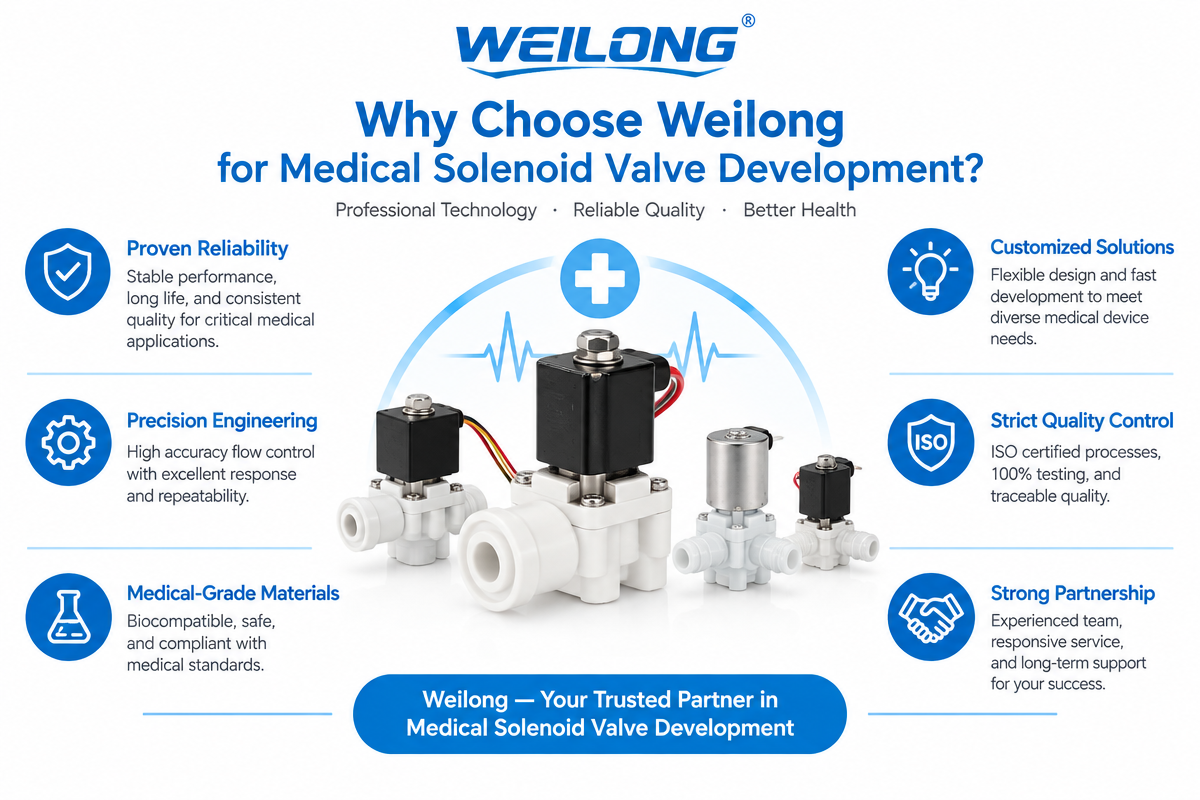
14. Why should Weilong be selected for medical solenoid valve development?
Selecting of the supplier can be more than just choosing of an existing component for an OEM manufacturer. Some special requirements can be put on valve: a certain range of pressure, flow rate, voltage, size, packaging and mounting, connectors, fluid-control function etc.
Weilong defines itself as an engineering oriented manufacturer with the capability of structural design, prototyping, tooling, testing, manufacturing and custom development of solenoids and solenoid valves. The current portfolio of products includes other electromechanical products like pumps, proportional valves and medical valves.
This product portfolio gives the additional advantage for OEM projects with a necessity of using several different fluid control components. For example, an application can require on/off valves in one part of the system, proportional flow control in another part and a small pump in the third one.
Quality Management is one of the criteria of selection of supplier. Weilong claims to have the quality-management systems certified in accordance with ISO 9001 and IATF 16949. It indicates the processes of design validation, process control, testing, traceability and continuous improvement.
A good discussion with the supplier will include topics like flow rate, pressure, leakage, response time, power consumption, materials, temperature, operating life, noise, size and production volumes.
This can help to detect design errors at the earlier stage and smooth the transition from prototype testing to production.If If you have a project in hands and need a solution, please contact Weilong sales team today.
Contact email : weilongsolenoid@gmail.com
Mobile/WeChat/Wahtsapp : 86 136 4298 0378
15. Frequently asked questions regarding medical solenoid valves
What is a medical solenoid valve?
Medical solenoid valves are electrically operated valves which are used to control the flow of gas or liquid in medical, diagnostic, laboratory or health care equipment. Internal armature movement is caused by the electromagnetic coil in order to open, close or redirect the fluid path .
Applications of Medical Solenoid Valves
Applications include ventilators, oxygen equipment, anesthesia systems, diagnostic analyzers, laboratory automation, suction equipment, dialysis related systems and other devices requiring automated gas or liquid control.
What is the distinction between a 2-way and 3-way medical valve?
In general a 2 way valve controls the flow of media from inlet to outlet. This allows changing , exhausting or diverting the media among different flow paths . Third port is used in a 3-way valve .
Do I want a normally open or a normally closed valve?
It depends on the fail state of the equipment. Normally closed valve stops the flow of media while being de-energized and normally open valve allows flow without electrical power. The selection should be determined by the safety and functional requirements of the equipment.
What voltage is preferable for medical solenoid valve?
There is no preferable voltage. The valve has to be compatible with the equipment's electrical system. Typical voltages are 5V, 12V and 24V, depending on the product. The availability depends on the valve design.
How important is the leakage performance?
Leakage is important, especially in gas isolation, vacuum systems, precise fluid control or sensitive analytical applications. Indicate the permissible internal and external leakage and the conditions of its measurement.
Choosing the Correct Valve Material
First of all you should take into account the process medium, temperature, pressure, cleaning method and material requirements of application. All wetted parts including body, seals, plunger, diaphragm, lubricants and adhesives are to be checked.
Are medical solenoid valves designed for continuous duty?
Some are, some are not. Before running the valve in continuous mode, check the coil duty cycle, power consumption, allowable temperature rise, ambient conditions and manufacturer's operating specifications.
When should I use a proportional valve instead of an on/off valve?
Simply start, stop, or change flow paths using an on/off valve. For continuous variation of flow or pressure in response to an electrical control signal, use a proportional valve.
What information is required to order a custom medical solenoid valve?
Process medium, flow rate, pressure, leakage requirement, voltage, duty cycle, temperature, response time, desired valve configuration, port style, available installation space, wetted material requirement, required service life, annual volume and special quality requirements.
16. Conclusion
The correct selection of medical solenoid valve should be performed on system level.
Start with the medium and determine how the valve has to operate with it. Then define the flow rate, pressure, vacuum, leakage, temperature, electrical supply, duty cycle, response time, operating life, dimensions, materials, cleanliness and environmental requirements.
Do not select the valve just because of its port size, voltage or price.
A valve satisfactory in one medical application might not be suitable for another because its media, operating pressure, flow rate accuracy, thermal environment or reliability requirements are absolutely different.
For OEM projects the early cooperation with the valve manufacturer is highly recommended. With the right operating conditions engineers will be able to select the suitable standard product or customize the valve.
In the end, the best medical solenoid valve is the one which satisfies the requirements of finished equipment in mechanical, electrical, fluidic, thermal and manufacturing aspects.
Weilong Technology
Weilong Technology
Legal Disclaimer:
EIN Presswire provides this news content "as is" without warranty of any kind. We do not accept any responsibility or liability for the accuracy, content, images, videos, licenses, completeness, legality, or reliability of the information contained in this article. If you have any complaints or copyright issues related to this article, kindly contact the author above.
