Hongrita as a Leading LSR Molder from China: Precision Molds and Smart LSR Molding in an Integrated Workflow
HONG KONG, HONG KONG, CHINA, October 28, 2026 /EINPresswire.com/ -- What should manufacturers expect from a Leading LSR Molder from China? The answer goes beyond owning liquid silicone rubber injection machines. A credible partner must control the relationship among part design, material behavior, mold accuracy, process stability, automation, inspection, and traceable production data. Hongrita’s position in this field is built around that connected model: precision tooling and intelligent molding are developed as one workflow rather than purchased as separate services. This approach is especially relevant as medical, infant-care, automotive, and smart-device programs demand tighter tolerances, cleaner production, and more consistent output.
Why LSR Manufacturing Is Becoming More Demanding
Liquid silicone rubber combines flexibility, temperature resistance, durability, and suitability for many skin-contact, food-contact, sealing, and electrical applications. It is also a two-part material that is metered, mixed, injected, and rapidly heat-cured. Industry material guidance identifies fast curing, reduced cycle time, and compatibility with injection molding as key processing benefits.
Those advantages do not make production simple. Low-viscosity LSR can escape through extremely small mold gaps, so shut-offs, parting lines, venting, and cold-runner control must be carefully engineered. Cure temperature, injection pressure, dosing accuracy, and demolding must also remain stable. When LSR is bonded to thermoplastics or metal inserts, the tool and process must manage different materials, temperatures, and adhesion requirements in the same production sequence.
The industry is therefore moving toward integrated engineering. Customers increasingly evaluate an LSR molder by its ability to reduce interfaces between design, toolmaking, molding, secondary operations, and quality control. Automation and digital process monitoring are also gaining importance as manufacturers seek repeatable cycles, documented parameters, lower manual handling, and earlier detection of variation.
Hongrita’s Integrated LSR Molding Solution
Founded in Hong Kong in 1988, Hongrita expanded from precision mold manufacturing into plastic molding, multi-material processes, and liquid silicone rubber technology. Its company history states that research into multi-material and multi-component molding began in 2003, followed by breakthroughs in LSR mold and molding technology in 2012. Today, the company operates manufacturing bases in Shenzhen and Zhongshan in China and Penang in Malaysia.
The practical value of this background is the connection between tooling knowledge and production engineering. Hongrita’s LSR molding solution can bring together a patented or application-specific mold, a configured molding machine, turntable systems, supporting equipment, inspection technology, and control software. Early engineering involvement supports design-for-manufacturing reviews, material and process selection, tooling feasibility, trial production, validation, and volume manufacturing.
At the center is the LSR Mold. Precision machining and measurement are essential because flash control, cavity balance, venting, and repeatable sealing directly affect part quality. Hongrita combines this discipline with multi-cavity tooling for higher output and multi-component molding for parts that integrate rigid and soft functions. In suitable applications, overmolding and in-mold assembly can reduce separate components and downstream assembly steps.
Smart Production as Part of Process Control
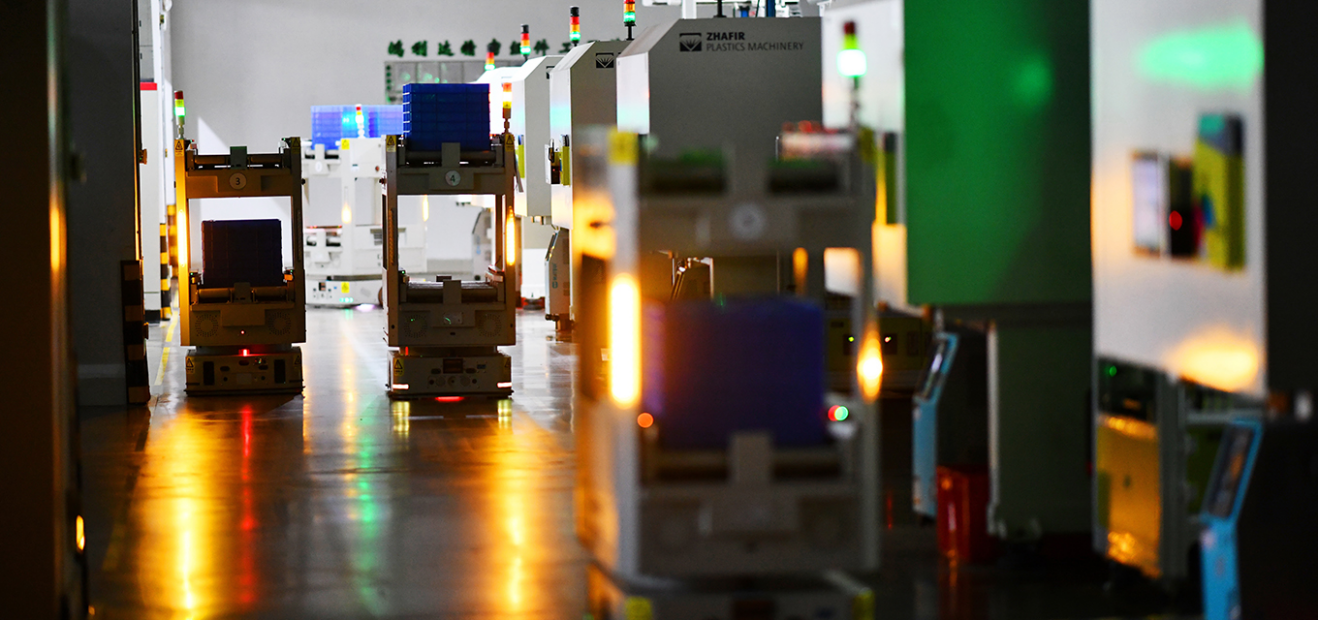
Hongrita describes its manufacturing model as the integration of molds, customized equipment, detection systems, and management software. Its digitalized intelligent manufacturing platform is intended to connect high-performance mold production, precision injection workshops, quality monitoring, and digital management.
For LSR Molding, this matters because consistency is determined by the entire cell. Automated feeding, part removal, inspection, and handling can limit contamination and operator-dependent variation. Production data can support parameter control, maintenance planning, traceability, and faster root-cause analysis. Digitalization does not replace moldmaking expertise, but it can make that expertise more repeatable across shifts and production sites.
The company lists ISO 9001, ISO 14001, IATF 16949, ISO 13485, ISO 45001, ISO/IEC 27001, and ISCC PLUS certifications, together with FDA registration. The relevance varies by program, but the combination indicates systems covering quality, environmental management, automotive production, medical devices, occupational health and safety, information security, and material traceability. For context, ISO 13485 remains the recognized quality-management standard for medical-device organizations.
Application Experience Across Regulated and High-Precision Sectors
Hongrita’s published application portfolio shows how the integrated workflow is used in practice.
Medical and Healthcare Components
The company’s medical manufacturing scope includes LSR molding, two-component silicone molding, in-mold assembly, and automated production. Representative programs cover respiratory masks, insulin-related components, syringes, blood-test tubes, blood-glucose-monitor parts, modular assemblies, and finished devices. These products illustrate the need for dimensional control, controlled production conditions, material compatibility, and documented manufacturing processes.
Mother and Baby Care
For infant feeding and soothing products, Hongrita reports experience with bottles, breast-pump components, cups, pacifiers, teethers, and tableware. Its workflow can extend from raw-material selection and product design to moldmaking, feasibility analysis, testing, pilot runs, food-grade production, assembly, silicone post-curing, and trimming. The case for integration is clear: a soft LSR feature, a rigid plastic structure, and an assembled product may need to be developed as one system rather than as isolated parts.
Automotive and E-Mobility
Automotive work described by Hongrita includes LSR wire seals, sensor components, control buttons, keyless-entry parts, pedals, dashboard parts, engine-related components, and ECU brackets. These applications draw on LSR, multi-component molding, metal-insert molding, and stack-mold capabilities. The company also states that its quality and engineering systems are intended for tier-one and tier-two supply programs, including luxury, Japanese OEM, and electric-vehicle requirements. In this sector, the growth of electrification increases the importance of reliable sealing, electrical protection, compact component integration, and automated inspection.
What Distinguishes the Workflow
Hongrita’s core advantage is not a single machine or process claim. It is the ability to coordinate four disciplines: high-precision mold engineering, LSR and multi-material process development, customized automation, and quality systems suited to demanding end markets. Multi-cavity molds can improve output when cavity-to-cavity balance is controlled; multi-component methods can consolidate functions; and digital monitoring can help maintain validated process windows.
This structure also supports practical risk reduction. DFM work can identify undercuts, sealing challenges, wall-thickness issues, bonding risks, and demolding constraints before steel is cut. In-house tool trials and measurement shorten the feedback loop between a defect and its engineering correction. Once production begins, automated handling and recorded process data help preserve the conditions established during validation.
Outlook for LSR Molding
The outlook for LSR is tied to broader changes in healthcare, mobility, consumer safety, and manufacturing automation. Medical and wearable devices are becoming smaller and more integrated. Electric vehicles require dependable seals and protection around connectors and electronics. Infant-care and consumer products continue to favor durable soft-touch components, while manufacturers face pressure to reduce material waste, manual assembly, and process variability.
These trends favor suppliers that can treat the LSR Mold, molding cell, inspection system, and production data as one engineered platform. Hongrita’s development from precision toolmaker to integrated LSR molder reflects that direction. Based on its published capabilities and application record, the company represents a China-based model in which precision molds and smart LSR Molding are managed within a continuous industrial workflow. Further company and capability information is available at https://www.hongrita.com/.
Hongrita
Hongrita
Legal Disclaimer:
EIN Presswire provides this news content "as is" without warranty of any kind. We do not accept any responsibility or liability for the accuracy, content, images, videos, licenses, completeness, legality, or reliability of the information contained in this article. If you have any complaints or copyright issues related to this article, kindly contact the author above.